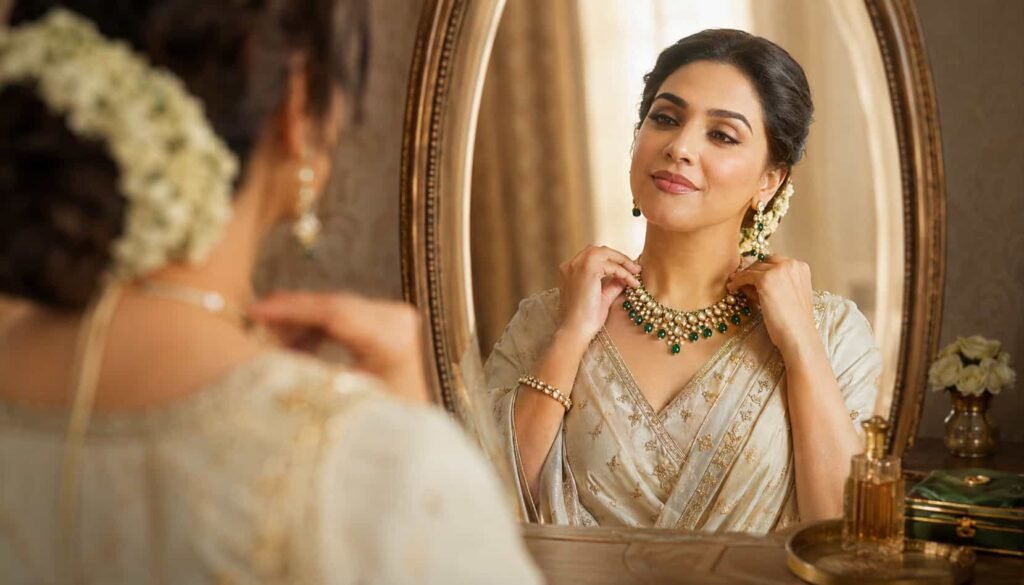
Have you ever worn a beautiful new necklace to one wedding, placed it back in its box and then found dark patches on it a few days later?
It can feel very disappointing.
You bought the jewellery because it looked rich, royal and perfect with your outfit. You expected to wear it at many weddings and festivals. But after one use, the colour looked dull, the chain appeared darker or the backside had black marks.
This may make you ask:
Is there any artificial jewellery that does not turn black after one use?
The honest answer is yes—and no.
Some materials, plating methods and protective coatings resist tarnish better than others. Good-quality jewellery can stay beautiful for a long time when you use and store it correctly. But no responsible seller should promise that every plated jewellery piece will remain exactly the same forever, no matter how it is worn.
Sweat, moisture, perfume, body lotion, chemicals, friction and storage conditions can all affect jewellery. Research on metals shows that sweat and body-fluid conditions can contribute to corrosion, while the chloride level, oxygen and pH of the surrounding environment can affect how metals react.
The good news is that you can greatly reduce the risk of your artificial jewellery turning black.
You only need to understand:
- What the jewellery is made from
- What kind of plating it has
- Whether it has a protective coating
- How you wear it
- How you clean it
- How you store it
This guide will explain all of these points in simple language.
“Anti-tarnish does not mean no-care. It means better resistance supported by the right material, finish and habits.”
Key Takeaways
Before going into detail, remember these important points:
- Jewellery can turn black because of moisture, sweat, chemicals, friction or weak plating.
- “Anti-tarnish” usually means tarnish-resistant, not permanently tarnish-proof.
- Brass can be a good base for premium Kundan and Polki-style jewellery, but its plating must be protected.
- Stainless steel with a suitable coating may resist tarnish well, but it is not commonly used for every heavy heritage design.
- Perfume, hairspray, lotion and makeup should dry before you wear jewellery.
- Artificial Kundan and Polki-style pieces should normally be cleaned with a soft, dry cloth.
- Never store jewellery while it is damp from sweat.
- Keep every jewellery piece separately instead of placing all pieces together.
- Ask the seller for material, plating, care and warranty information before buying.
- Be careful with sellers who promise “100% waterproof forever” without explaining the material or warranty.
What Does “Artificial Jewellery That Does Not Turn Black” Really Mean?
When shoppers use this phrase, they usually want jewellery that:
- Does not become dark after one function
- Does not lose its shine quickly
- Does not leave obvious black marks
- Does not look cheap after storage
- Can be worn more than once
- Remains suitable for future weddings and festivals
In the jewellery market, you may see terms such as:
- Anti-tarnish
- Tarnish-resistant
- Waterproof
- Sweat-resistant
- Long-lasting polish
- Premium plating
- Protective coated
- PVD coated
- E-coated
- Rhodium plated
These terms do not all mean the same thing.
Tarnish-resistant
The jewellery is designed to slow down colour change, oxidation or dullness.
Anti-tarnish
This is often used as a marketing term for jewellery with a better-quality metal, plating or protective layer. You should still ask what material and coating are used.
Waterproof
This suggests that the product can handle water exposure. However, not every seller uses this term in the same way. “Waterproof” should not automatically be understood as permission to swim, bathe or use perfume while wearing a piece.
Sweat-resistant
This generally means that the finish may handle normal perspiration better than ordinary jewellery. It does not mean that sweat has no effect at all.
PVD coated
Physical vapour deposition, or PVD, is a coating process that can improve surface strength and resistance. However, research on decorative coatings notes that direct PVD coating on brass may not always provide enough corrosion protection by itself; layered plating and coating systems may perform better.
This is why you should not judge jewellery only by one word.
You should look at the complete product:
Base metal + plating + coating + craftsmanship + care instructions
Why Does Artificial Jewellery Turn Black?
Artificial jewellery does not normally turn black for one single reason. Several things may happen at the same time.
Understanding the cause can help you prevent it.
1. Sweat remains on the jewellery
Indian weddings and festivals often involve:
- Warm weather
- Crowded halls
- Heavy outfits
- Long functions
- Dancing
- Outdoor events
Your necklace, earrings or bangles may remain in contact with sweat for many hours.
Sweat contains water, salts and other substances. Metal studies use artificial sweat to test corrosion and metal-ion release because perspiration can affect metal surfaces.
If you remove the jewellery and directly close it inside a box, the moisture may remain trapped against the metal.
This can make the finish dull or dark.
2. Perfume and hairspray touch the jewellery
Many people complete their makeup, spray perfume and then immediately wear jewellery.
Sometimes perfume is sprayed again after the jewellery is already on.
This can expose the surface to alcohol, fragrance oils and other ingredients. Cosmetics, hairspray, perfume and perspiration can affect some jewellery and gem materials. GIA advises protecting jewellery materials from such chemical exposure.
The safest rule is:
Complete your makeup and perfume first. Let everything dry. Wear the jewellery last.
3. Lotion, cream or makeup collects behind the piece
Foundation, body lotion, sunscreen and moisturiser may collect:
- Behind a necklace
- Around earring posts
- Under bangles
- Between stones
- Near clasps
- On the back of a pendant
This can create a sticky layer that holds dust and moisture.
The jewellery may look black, dirty or patchy even when part of the issue is surface buildup.
4. The plating is thin or uneven
Artificial jewellery often uses one metal as its base and another finish on top.
For example:
- Brass base with gold-tone plating
- Alloy base with antique-gold finish
- Silver-colour finish with rhodium-style plating
- Copper-based metal with decorative polish
If the outer layer is thin, uneven or poorly bonded, friction may expose the base metal quickly.
Common friction areas include:
- Necklace chains
- Earring posts
- Bangle edges
- Ring bands
- Clasp points
- The back of pendants
- Parts that touch the skin
5. Moisture is trapped during storage
Humidity can affect metal and plated surfaces.
Jewellery stored in a damp bathroom, near a window, inside wet fabric or in a humid cupboard may change faster.
Placing jewellery in a closed box while it is still damp can also increase the problem.
6. Different products react differently
Not every artificial jewellery piece has the same material.
Two necklaces may look similar in a photograph but use:
- Different base metals
- Different plating thickness
- Different adhesives
- Different stones
- Different topcoats
- Different finishing methods
This is why price and appearance alone do not tell you how the jewellery will perform.
7. Your body chemistry and daily routine matter
Some people sweat more than others.
Some people use strong perfume, body oils, creams or medicated skincare. Some live in humid areas. Others wear jewellery for ten hours at a wedding.
The same piece may age differently for two people because their use conditions are different.
8. Harsh cleaning damages the finish
People sometimes use:
- Toothpaste
- Baking soda
- Lemon
- Vinegar
- Detergent
- Sanitiser
- Metal polish
- Hard toothbrushes
These may be too strong or abrasive for plated artificial jewellery.
A method that works for one solid metal may damage:
- Thin plating
- Antique polish
- Imitation stones
- Pearl coating
- Foil backing
- Adhesive
- Enamel
- Thread work
Do not use a viral cleaning hack unless it is suitable for the exact material of your jewellery.
Did the Jewellery Turn Black, or Did It Leave a Black Mark?
These are not always the same problem.
Jewellery tarnish
The surface of the jewellery itself becomes:
- Dark
- Dull
- Patchy
- Brown
- Grey
- Black
- Greenish near the base metal
A black mark on your skin
Sometimes the jewellery looks normal, but you see a dark line or mark on the skin.
Research on contact with certain metal alloys has found that black marks may sometimes come from tiny metallic particles created through friction with substances on the skin.
Makeup, powder, cream, sweat and friction may all play a part.
If you see a skin mark:
- Remove the jewellery.
- Wash and dry the skin gently.
- Wipe the jewellery with a soft, dry cloth.
- Check whether the jewellery surface has changed.
- Stop using the piece if you have itching, redness, swelling or discomfort.
A black mark is different from an allergic reaction.
Do not assume a product is “hypoallergenic” or “nickel-free” unless the seller can support that claim. Nickel can be released from some alloys under artificial-sweat testing conditions, and people with metal sensitivity may react differently.
Which Artificial Jewellery Materials Last Longer?
There is no single material that is best for every design.
A delicate daily-wear chain and a heavy Kundan bridal necklace need different construction.
Here are the common options.
1. Stainless-Steel Jewellery
Good-quality stainless steel is often chosen for:
- Daily-wear chains
- Minimal earrings
- Bracelets
- Rings
- Modern waterproof-style jewellery
It can offer good resistance to corrosion, especially when the grade and coating are suitable.
PVD-coated stainless steel is commonly promoted for daily wear because the finish may be more resistant than basic flash plating.
However:
- Not every seller states the exact steel grade.
- Not every PVD coating has the same quality.
- Scratching and wear can still occur.
- Stones and adhesives may still require care.
- Heavy traditional Kundan designs are not always made in stainless steel.
Choose stainless steel when you want simple, modern and more frequent-wear jewellery.
Do not assume that every gold-colour steel product is automatically waterproof forever.
2. Brass-Based Jewellery
Brass is widely used for premium fashion jewellery because it can be shaped into detailed designs.
It is suitable for:
- Kundan necklace sets
- Polki-style sets
- Antique jewellery
- Heritage necklaces
- Statement earrings
- Temple-inspired jewellery
- Bridal jewellery
Brass can give a piece:
- A rich feel
- Better structure
- A traditional shape
- Satisfying weight
- Detailed workmanship
But brass is a copper-and-zinc alloy, and copper-based surfaces can react with the surrounding environment. Alloy composition and surface protection influence corrosion resistance.
This does not mean brass jewellery is poor quality.
It means the quality of its:
- Plating
- Undercoat
- Protective coating
- Finishing
- Storage
- Care
becomes very important.
For JewelPatakha’s type of Kundan, Polki-style, antique and heritage jewellery, brass can be a suitable base when the finishing is good and the customer follows occasion-jewellery care.
3. Rhodium-Plated Jewellery
Rhodium plating is normally used for a bright white or silver-like finish.
It may be found on:
- AD jewellery
- White-stone jewellery
- Silver-tone necklaces
- Earrings
- Bracelets
Rhodium is also used as a protective finish on some jewellery materials. GIA notes that rhodium plating can help protect silver from tarnishing, although all plating can wear with time and use.
Before buying, ask:
- What is under the rhodium plating?
- Is it intended for daily or occasion wear?
- Does the seller provide any coating warranty?
- How should it be cleaned?
4. Gold-Plated Jewellery
Gold-plated artificial jewellery has a gold-colour layer over another base metal.
Its life depends on:
- Base metal
- Surface preparation
- Plating thickness
- Plating process
- Protective top layer
- Friction
- Sweat
- Water
- Storage
“Gold plated” alone does not tell you how long the finish will last.
A ₹500 and a ₹5,000 product may both use the term, yet their construction, stones, weight, finishing and plating process can be very different.
Look for clear information rather than only the phrase “premium gold plated.”
5. Mixed-Metal Alloy Jewellery
Mixed alloys are common in lower-cost and mass-produced jewellery.
Performance can vary widely.
Some pieces may remain attractive for many wears. Others may change quickly.
The challenge is that “alloy” does not tell you exactly what is inside it.
Ask the seller whether they can share:
- Base-metal category
- Plating type
- Care instructions
- Skin-sensitivity information
- Product warranty
What Is Best for Kundan, Polki and Heritage Jewellery?
For heavy Indian occasion jewellery, you should not judge quality only by whether the material is called “anti-tarnish.”
The full design matters.
A premium Kundan or Polki-style set may include:
- Brass or alloy framework
- Gold-tone or antique plating
- Imitation Kundan or Polki-style stones
- Glass stones
- Beads
- Imitation pearls
- Enamel work
- Thread
- Adhesive
- Metal hooks and chains
Even when the metal finish is strong, the stones, pearls, thread and adhesive may not be suitable for water.
This is why a heavy occasion necklace should not be treated like a plain stainless-steel chain.
For Kundan and Polki-style jewellery
Follow these rules:
- Keep it away from water.
- Do not spray perfume over it.
- Do not soak it.
- Do not use toothpaste or metal cleaner.
- Wipe only the backside and safe metal surfaces gently.
- Do not rub stones aggressively.
- Store the set flat where possible.
- Keep earrings and necklace pieces from scratching each other.
- Protect hanging beads and pearl drops.
- Do not keep a heavy necklace suspended for long periods.
“A royal-looking piece may be strong enough for a celebration, yet delicate enough to need thoughtful storage.”
How to Choose Artificial Jewellery That Will Not Turn Black Quickly
Use this buying checklist before placing an order.
1. Ask for the base metal
Look for details such as:
- Brass
- Stainless steel
- Copper alloy
- Mixed alloy
- Other metal
A seller may not always have the full laboratory composition, but they should provide the available material information honestly.
Avoid listings that use only vague claims such as:
- Best quality
- Imported quality
- Guaranteed quality
- Premium metal
without any practical product information.
2. Ask what kind of finish is used
Useful descriptions include:
- Gold-tone plated
- Antique gold
- Matte gold
- Rhodium plated
- Oxidised finish
- PVD coated
- Protective lacquered
- E-coated
Ask whether the finish is designed for:
- Daily wear
- Occasional wear
- Bridal wear
- Short event wear
A product can be high quality but still be intended mainly for occasion use.
3. Check whether “anti-tarnish” has a clear meaning
Ask:
- What makes it anti-tarnish?
- Is the base stainless steel?
- Is there a PVD coating?
- Is there a protective topcoat?
- Is there a written warranty?
- What activities are excluded?
- Can it be worn in water?
- Can it be exposed to perfume?
- Is it suitable for daily wear?
A clear answer is more valuable than a large “ANTI-TARNISH” badge.
4. Look at real product images
A strong product page should show:
- Front view
- Backside
- Chain
- Hook or clasp
- Earring post or closure
- Stone setting
- Full set
- Worn scale
- Packaging
Natural-light videos can help you understand the actual gold tone and shine.
This matters because JewelPatakha’s ideal customer is especially concerned about pieces looking cheap, brassy or plastic-like in real life. She values real reviews, natural-light visuals and close-up detail before buying.
5. Check the backside finishing
Customers often focus only on the front.
But the backside tells you a lot.
Look for:
- Clean edges
- Neat soldering
- Proper stone backing
- Smooth surface
- Secure hooks
- No sharp points
- Even colour
- Strong chain attachment
The backside is also the area most likely to touch:
- Sweat
- Makeup
- Lotion
- Skin
A clean, well-finished backside improves comfort and trust.
6. Read the care instructions before buying
A good jewellery seller should explain:
- Whether the item can touch water
- Whether it is for occasion or daily use
- How to clean it
- How to store it
- Whether perfume should be avoided
- Whether the product has a warranty
- What normal wear means
Care instructions should not be hidden only after the purchase.
7. Check the return and exchange policy
Before buying, know what happens when:
- The product arrives damaged
- The wrong item is delivered
- A component is missing
- The colour is materially different
- The product has a manufacturing defect
- You simply change your mind
A clear return policy does not guarantee that the jewellery will never tarnish, but it shows that the business takes customer concerns seriously.
8. Do not judge quality only by price
A higher price may reflect:
- Better design
- Hand-finishing
- More stones
- Heavier construction
- Better packaging
- Limited stock
- Brand service
- Product photography
- Quality checking
But price alone does not prove that an item is waterproof, hypoallergenic or tarnish-proof.
Read the product details.
9. Look for product-specific promises
A brand may sell many categories.
One collection may be:
- PVD-coated daily-wear jewellery
Another may be:
- Brass-based occasion Kundan jewellery
Do not apply the promise of one collection to every product.
The product page should be your main source of information.
10. Ask for a product video when you are unsure
Before buying a high-value artificial jewellery set, ask for:
- Natural-light video
- Close-up of stones
- Backside video
- Approximate weight
- Necklace length
- Earring size
- Colour confirmation
This is especially useful when buying jewellery for:
- Your wedding
- A family wedding
- Diwali
- Engagement
- Reception
- Important gifting
- A planned outfit
How to Prevent Artificial Jewellery from Turning Black
Good care begins before the jewellery touches your skin.
Step 1: Get ready first
Complete:
- Skincare
- Makeup
- Hair styling
- Hairspray
- Perfume
- Deodorant
- Body lotion
Then wait for the products to dry.
Wear jewellery last.
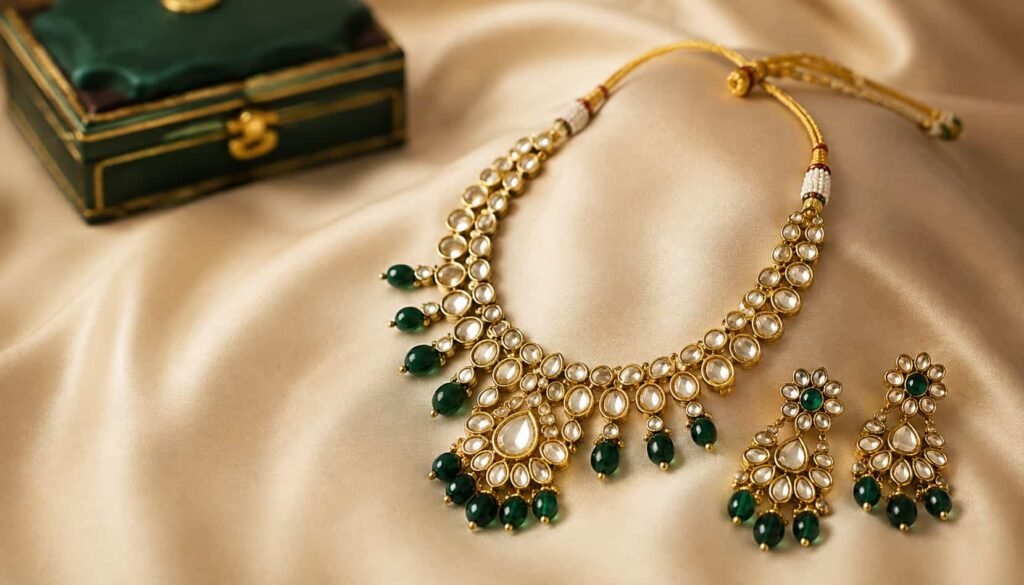
This reduces direct chemical contact. GIA’s jewellery-care guidance also recommends protecting jewellery materials from cosmetics, perfume and similar products.
Step 2: Make sure your skin is dry
Before wearing a necklace or bangles, check that your skin is not wet from:
- Bathing
- Moisturiser
- Sweat
- Perfume
- Hair products

If you are attending an outdoor wedding, carry a soft tissue or cloth so you can gently manage sweat near the neck.
Do not repeatedly wipe stones or plating during the function.
Step 3: Do not apply perfume after wearing jewellery
Spray perfume on:
- Pulse points away from the jewellery
- Your clothes, where safe for the fabric
- Your body before the jewellery is worn

Never spray it directly on a necklace, earrings or bangles.
Step 4: Keep jewellery away from water
Remove artificial jewellery before:
- Bathing
- Swimming
- Washing your face
- Washing dishes
- Exercising
- Visiting a spa
- Using steam
- Applying a wet hair treatment
Even when a metal coating resists water, the stones, pearls, enamel, threads or adhesive may not.
Step 5: Remove it after the event
When you return home, remove jewellery before:
- Washing your face
- Changing clothes roughly
- Taking a shower
- Sleeping
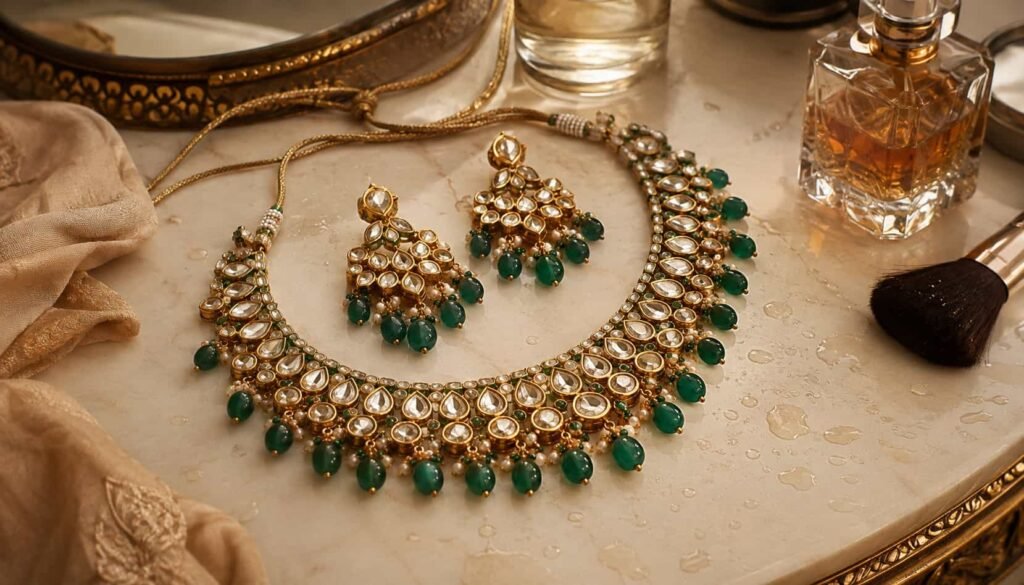
Do not leave a heavy necklace on the dressing table for the entire night.
Step 6: Let moisture dry
Do not immediately seal sweaty jewellery inside a pouch.
Place it in a clean, dry area for a short time.
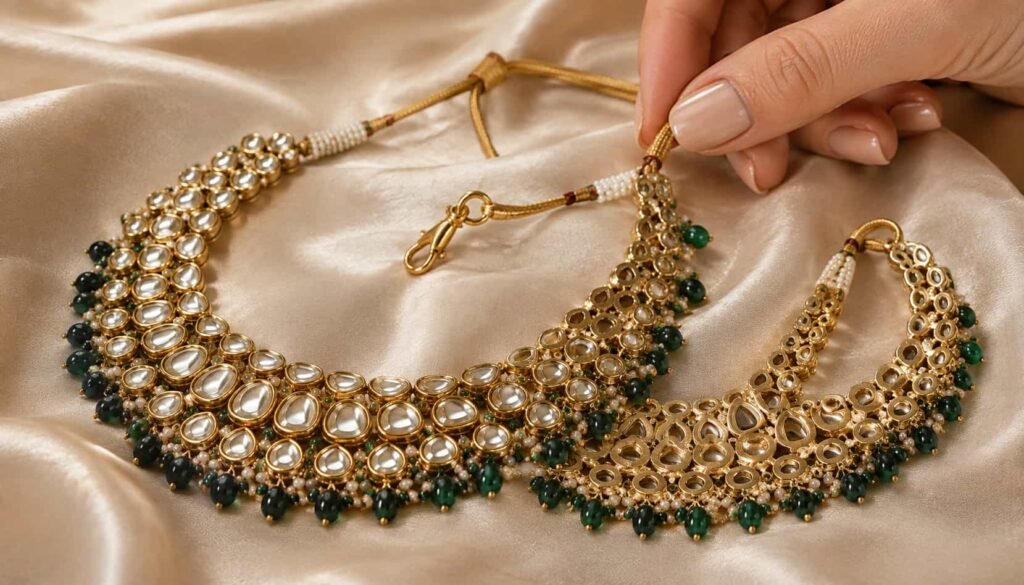
Keep it away from:
- Direct sunlight
- Strong heat
- Bathroom moisture
- Open windows during rain
- Air-conditioner water drops
Once it is fully dry, wipe and store it.
Step 7: Wipe it gently
Use:
- Soft microfibre cloth
- Clean cotton cloth
- Soft lint-free cloth
Gently wipe the metal surface that touched your skin.
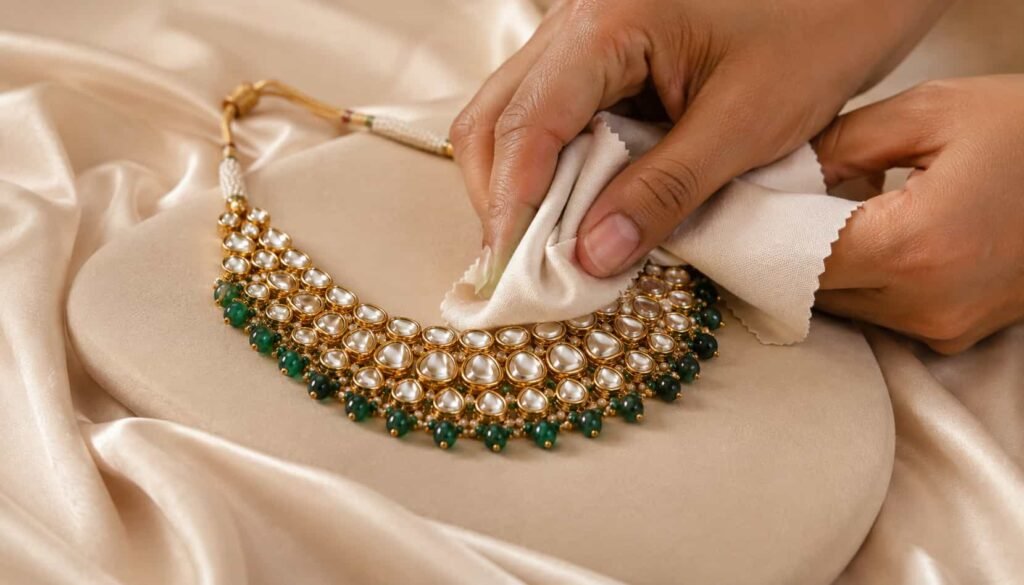
Do not:
- Scrub
- Polish aggressively
- Pull beads
- Rub foil-backed stones
- Bend the setting
- Use a wet wipe unless the seller approves it
For intricate Kundan or Polki-style jewellery, use a very soft, clean, dry brush only when necessary and only with light pressure.
Step 8: Store every piece separately
Do not throw all your jewellery into one box.
Pieces may:
- Scratch each other
- Pull each other’s chains
- Break beads
- Damage plating
- Bend hooks
- Loosen stones
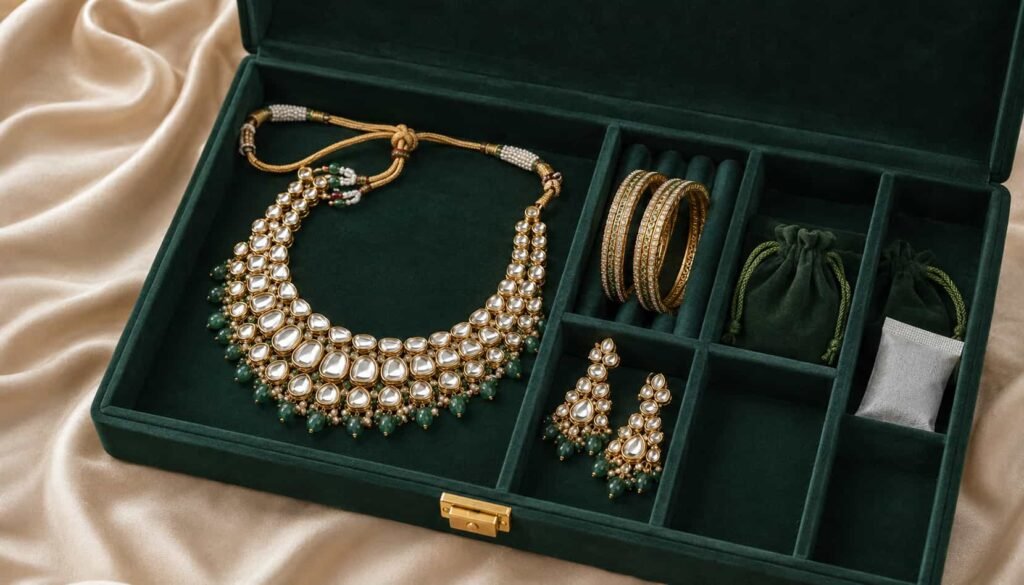
Store:
- Necklace separately
- Earrings separately
- Bangles in their own section
- Rings in a soft slot
- Heavy sets flat
Use the original pouch or suitable dry packaging where available.
Step 9: Control moisture in storage
Keep jewellery in a cool and dry place.
You may place a small moisture-control packet in the outer storage box, provided it does not directly rub against the jewellery and is kept away from children.
Replace moisture-control packets when needed.
Do not use damaged or leaking packets.
Step 10: Rotate your jewellery
Do not wear the same plated piece every day unless it is specifically made for daily wear.
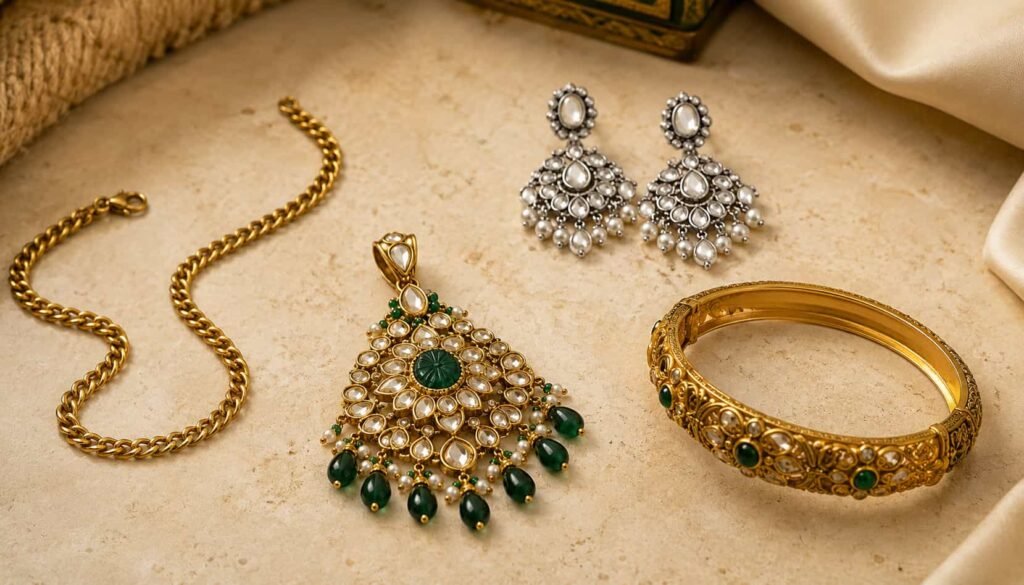
Rotating your jewellery:
- Reduces repeated friction
- Gives pieces time to dry
- Limits chemical exposure
- Helps the finish last longer
- Gives you more styling options
What to Do Immediately After One Use
Follow this simple five-minute routine.
Minute 1: Remove carefully
Open the hook or clasp properly.
Do not pull the necklace over your head unless it is designed that way.
Minute 2: Inspect
Check:
- Stones
- Beads
- Chain
- Hooks
- Posts
- Threads
- Backside
Early attention can prevent a small loose part from becoming a bigger problem.
Minute 3: Dry
Leave the jewellery in a safe, dry place if it feels warm or damp.
Minute 4: Wipe
Gently wipe the skin-contact areas.
Minute 5: Store
Place each piece in the correct pouch or compartment.
This small routine can make a big difference.
Common Jewellery-Care Mistakes
Mistake 1: Wearing jewellery before perfume
This allows fragrance and moisture to sit under the product.
Mistake 2: Keeping sweaty jewellery inside the box
This traps moisture.
Mistake 3: Using toothpaste
Toothpaste can be abrasive and may damage plating or stones.
Mistake 4: Soaking Kundan jewellery
Water may affect plating, backing, adhesive, stones, beads or thread.
Mistake 5: Using sanitiser on jewellery
Sanitiser contains alcohol and other ingredients that may affect certain finishes.
Mistake 6: Storing every piece together
This causes scratching and tangling.
Mistake 7: Wearing occasion jewellery every day
Heavy heritage-style jewellery is usually designed for events, not bathing, sleeping and exercise.
Mistake 8: Trusting every waterproof claim
Ask for material and warranty details.
Mistake 9: Applying transparent nail polish
People sometimes coat jewellery with nail polish. This may look uneven, change colour, trap moisture or react with the existing finish.
Do not apply it to premium jewellery unless the seller specifically recommends it.
Mistake 10: Cleaning all jewellery in the same way
A plain steel chain, pearl earring and Kundan necklace need different care.
Myths About Anti-Tarnish Artificial Jewellery
Myth 1: Anti-tarnish means it can never change colour
Truth: It usually means better resistance, not permanent protection.
Myth 2: Expensive jewellery never turns black
Truth: Price can reflect quality, design and service, but wear conditions still matter.
Myth 3: Waterproof means perfume-proof
Truth: Water resistance does not automatically mean resistance to every cosmetic or chemical.
Myth 4: Brass is always low quality
Truth: Brass is commonly used for structured, detailed fashion jewellery. Its finishing and care are important.
Myth 5: Stainless steel is best for every design
Truth: It may work very well for minimal daily-wear jewellery, but not every traditional Kundan or heritage piece is suited to steel construction.
Myth 6: Jewellery that turns dark is always fake
Truth: Even precious metals and high-purity gold products can show certain tarnish or surface marks under particular conditions.
Myth 7: Lemon and baking soda safely clean everything
Truth: Harsh or acidic methods may damage plated jewellery, pearls, stones, enamel or adhesive.
Can You Restore Artificial Jewellery That Has Turned Black?
Sometimes you can improve the appearance. Sometimes the plating has worn away and professional refinishing is needed.
Start carefully.
When it may only be surface buildup
If the jewellery looks dull because of:
- Makeup
- Oil
- Dust
- Light sweat residue
a gentle dry wipe may help.
When plating has worn away
If you see:
- Different-colour metal below the surface
- Uneven patches
- Dark exposed edges
- Strong green or brown areas
- Peeling coating
home cleaning may not restore the original finish.
The product may require:
- Professional replating
- Repair
- Replacement
- Retirement from use
Do not experiment on the whole piece
Before using any approved cleaning method, test a tiny hidden area.
For high-value or detailed Kundan jewellery, ask the seller or an experienced jewellery professional before cleaning.
How Long Should Artificial Jewellery Last?
There is no single correct number.
The useful life depends on:
- Material
- Plating
- Protective coating
- Frequency of wear
- Sweat exposure
- Climate
- Storage
- Cleaning
- Friction
- Product design
- Individual care
A necklace worn carefully for three weddings may remain newer than a chain worn every day in heat, perfume and water.
Ask a better question:
“How is this product designed to be worn, and what care does it need?”
That answer is more useful than a general promise.
What JewelPatakha Customers Should Look For
JewelPatakha specialises in premium artificial Kundan, Polki-style, antique and heritage-inspired jewellery for weddings, festivals, parties and gifting.
These pieces are designed to create a rich occasion look.
Before purchasing, check:
- Product material
- Plating or finish
- Approximate dimensions
- Approximate weight
- Included components
- Real product photographs
- Care instructions
- Return eligibility
- Dispatch time
You may also request available product videos through JewelPatakha’s official WhatsApp support.
At JewelPatakha, the responsible approach is not to promise that every artificial jewellery product will remain unchanged forever.
The better promise is:
- Clear product information
- Realistic care guidance
- Quality inspection
- Secure packaging
- Customer assistance
- Honest product-specific claims
“The best jewellery promise is not ‘never black.’ It is honest information that helps you buy, wear and care with confidence.”
Frequently Asked Questions
1. Which artificial jewellery does not turn black?
Stainless-steel jewellery with a suitable protective coating may offer good tarnish resistance for many daily-wear designs. Properly plated and coated brass jewellery can also last well for occasions. No material should be assumed to remain unchanged forever without checking its exact construction, care instructions and warranty.
2. Why did my artificial jewellery turn black after one use?
Possible reasons include sweat, moisture, perfume, body lotion, makeup, weak plating, friction or damp storage. Sometimes the dark appearance is surface residue; in other cases, the plating may have started wearing.
3. Is brass jewellery good?
Yes, brass can be suitable for detailed Kundan, Polki-style, antique and heritage jewellery. Its quality depends greatly on plating, protective coating, workmanship and care.
4. Does gold-plated jewellery turn black?
Gold-plated jewellery may change over time if the plating wears or the base metal reacts with moisture, sweat or chemicals. Better plating and proper care can slow this process.
5. Is anti-tarnish jewellery completely waterproof?
Not always. “Anti-tarnish” and “waterproof” are different claims. Even when the metal resists water, stones, pearls, thread, adhesive and enamel may still require protection.
6. Can I wear artificial jewellery in the shower?
Do not wear it in the shower unless the seller clearly states that the complete product—not only the metal—is suitable for water exposure.
7. Can perfume turn jewellery black?
Perfume and other cosmetic products may affect some plating, metals and gem materials. Apply perfume first, allow it to dry and wear the jewellery afterwards.
8. How should I clean artificial jewellery?
Use a clean, soft and dry cloth unless the product instructions recommend another method. Avoid soaking, harsh chemicals, toothpaste, lemon and abrasive cleaners.
9. How should I store artificial jewellery?
Store each piece separately in a dry pouch, box or compartment. Make sure the product is free from sweat and moisture before storage.
10. Can I keep artificial jewellery in plastic bags?
A clean, dry pouch may help separate the jewellery, but the item must be completely dry before sealing. Do not trap sweat or moisture inside.
11. Is stainless-steel jewellery better than brass?
Stainless steel may offer better resistance for many simple daily-wear designs. Brass is often more suitable for detailed traditional and statement jewellery. The right choice depends on the design and intended use.
12. Can I clean Kundan jewellery with water?
It is safer to avoid water unless the seller gives product-specific permission. Water may affect plating, stone backing, adhesive, thread, beads or enamel.
13. Does artificial jewellery cause skin allergy?
Some people may react to particular metals or finishes. Do not rely on “hypoallergenic” or “nickel-free” claims unless they are supported for the specific product. Stop wearing a piece if you experience itching, redness, swelling or discomfort.
14. Why does jewellery leave a black mark on my neck?
The mark may result from friction, cosmetics, skin products, sweat or tiny metal particles. It does not always mean the entire necklace has turned black. Clean the skin and jewellery gently and inspect both.
15. Can I use transparent nail polish to protect jewellery?
It is not recommended for premium or stone-set jewellery unless the seller approves it. It may look uneven, react with the finish or damage stones and adhesive.
16. Is artificial jewellery suitable for daily wear?
Some collections are designed for daily wear. Heavy Kundan, Polki-style and heritage jewellery is normally better suited to weddings, festivals and special occasions.
17. How do I know whether an anti-tarnish claim is genuine?
Ask what base metal, plating and coating are used. Check whether the seller provides written care instructions and a clear product-specific warranty.
18. Can tarnished jewellery be replated?
Some metal jewellery can be professionally replated, but the possibility depends on its construction, stones, adhesive and condition.
19. Should I record an unboxing video?
An unboxing video can help document the product’s condition at delivery, especially for high-value necklace sets, missing components or transit-damage claims.
20. How can I keep my artificial jewellery shiny for longer?
Wear it after makeup and perfume, avoid water and chemicals, remove it after the event, wipe it gently, let it dry and store every piece separately.
Final Key Takeaways
- No responsible seller should promise that every artificial jewellery piece will never change colour under every condition.
- Tarnish resistance depends on the base metal, plating, coating, use and care.
- Sweat, perfume, lotion, moisture and friction are common causes of fast colour change.
- Stainless steel may suit frequent-wear designs, while plated brass is widely used for rich Kundan and heritage jewellery.
- “Anti-tarnish” does not always mean waterproof.
- Wear jewellery last and remove it first.
- Never store it while damp.
- Avoid harsh home-cleaning hacks.
- Ask for real photographs, material details, care instructions and return terms.
- Honest product information is more valuable than an impossible lifetime promise.
Conclusion
Artificial jewellery should bring you joy, confidence and styling freedom—not worry after every function.
The right piece can give you the royal look of traditional jewellery without the cost and security concerns of carrying heavy real gold. But to enjoy that value, you must choose carefully and care for the product correctly.
Look beyond the words “premium” and “anti-tarnish.”
Ask what the jewellery is made from. Understand whether it is meant for daily wear or special occasions. Protect it from sweat, water, perfume and chemicals. Give it a few minutes of care after every use.
A small routine can help your favourite jewellery stay ready for many more celebrations.
JewelPatakha curates premium Kundan, Polki-style, antique and heritage-inspired artificial jewellery for Indian weddings, festivals, parties and gifting. Explore each product’s material and care details, or contact JewelPatakha for available real-product videos and assistance before placing your order.